Locations





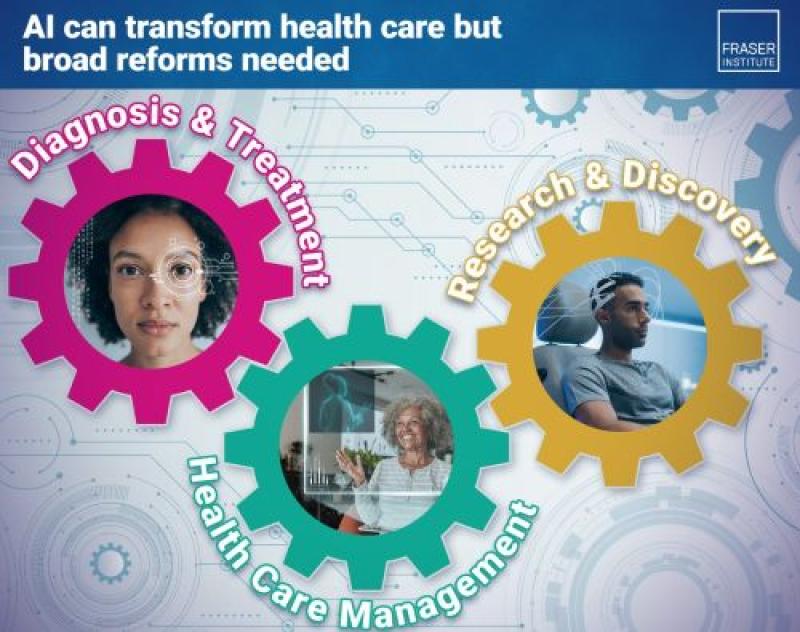
A 2026 Fraser Institute study reports AI could make health care more productive and patient-focused, but only if health care systems are redesigned with AI at their core.
The Vancouver-based Fraser Institute’s study How Implementing System-Wide Solutions Can Amplify the Impact of Artificial Intelligence on Health Care argued AI is already being used in healthcare operations around the world. The problem is those applications are limited to “point solutions,” where AI tools are inserted into existing workflows to overcome bottle necks and used more widely.
This limited use of AI brings about marginal improvements in health care. For more substantial productivity gains, health care operations and systems need to be redesigned with AI at the centre.
Study author Avi Goldfarb, the Rotman chair in artificial intelligence and healthcare at the Rotman School of Management at the University of Toronto, compared how AI is currently being used to the introduction of electricity into factories. At first, central steam engines were replaced by a single electric motor. This left the rest of the factory and its systems to operate as before. Little benefit was had by doing so.
The benefit of electricity was only seen when small electric motors were introduced throughout a factory, changing how many operations were done. Those small electric motors eliminated the need for shafts and belts, and new machines could be added that increased productivity.
“In other words, productivity gains did not come from simply dropping electricity into the old system, but from reorganizing the system around the new technology,” Goldfarb explained in the study.
Today, AI is only reinforcing existing workflows instead of fundamentally transforming them, much in the same way electricity was first introduced into factories, according to Goldfarb. The report argues instead that AI will only deliver large-scale productivity improvements when health systems redesign workflows, roles and institutions around AI.
More human-centred care
Where AI can have an impact is on frontline physician care, assisting doctors to make faster diagnostic decisions in primary care situations and ease bottlenecks where there are physician shortages. AI can allow non-physician clinicians to handle diagnosis and free up doctors to focus on complex cases.
“Diagnosis is, at its core, a prediction problem: given data on symptoms, what is the most probable underlying condition? As machine learning systems improve, they will soon outperform many human physicians in certain areas of diagnosis,” Goldfarb wrote in the report.
If machines can handle much of the prediction, “then the human role in the diagnostic process can shift. Nurses, pharmacists, or other trained professionals could work alongside AI systems, where the AI provides the frontline diagnoses, suggest and implement treatments, and escalate cases to physicians when necessary.”
AI could also help physicians be more productive by eliminating certain time-consuming tasks. AI-enabled transcription services can eliminate the need to type up reports. AI could also automate many systems, such as coordinating patient follow-ups, prescriptions and test results, allowing health care staff to spend more time with patients.
“A true system solution would reconfigure healthcare management so that technology fades into the background and human connection moves to the forefront,” Goldfarb added. “Physicians look at patients rather than machines . . . the administrative machinery runs quietly in the background.”
Achieving these desired results remains a challenge. The report said hurdles such as regulations and professional boundaries need to be overcome for AI to be integrated successfully in health care settings. Goldfarb believes the promise of AI will overcome those barriers, slowly at first then much more quickly as institutions begin using AI more widely, allowing healthcare leaders to put patient care at the core of their operations.
“The key challenge for healthcare leaders is to determine how AI can help their organizations deliver on the mission of high quality patient care, and then implement the system changes necessary to make that happen,” he added.


 Industry Events
 Locations