
 Locations





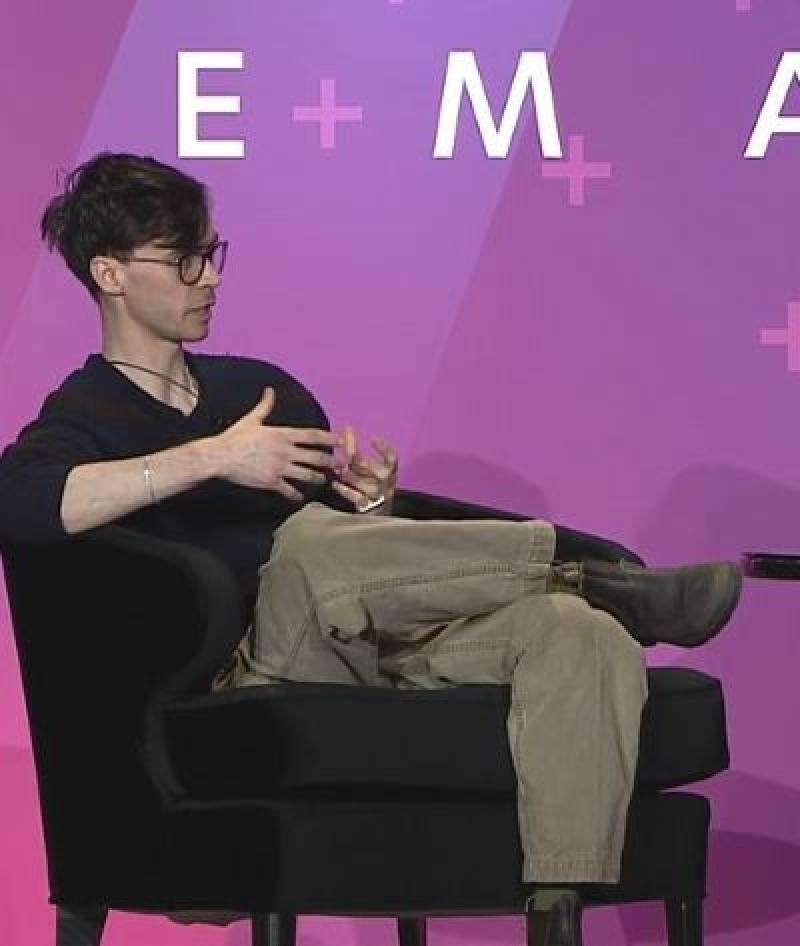
Canada needs to build a home-grown AI ecosystem that reflects Canadian business needs and values, not ones defined or directed by Silicon Valley. says Cohere co-founder Nick Frosst.
“For the past several decades, most of the world's experience of technology has been defined by Silicon Valley,” Frosst told attendees at the third annual Vector Institute AI research conference in Toronto. “It has been defined by America, and I think at this stage we're all pretty aware that isn't great, that the vision of life, that the view of the way the world should be coming out of Silicon Valley is not really the one that a lot of the world wants.
"Especially, it's not the one that Canada wants.”
He suggested the way of doing that is to start moving from pure AI research and development to rolling out scalable, commercial products. “That means Canada doesn't need to be just following the vision of tech that comes out of the States, but instead we can be making our own,” Frosst added.
Frosst co-founded AI-startup Cohere in 2019 with Aidan Gomez and Ivan Zhang after spending several years doing pure research at Google Brain.
The Toronto-based firm specializes in large language models and AI products for regulated industries such as finance, healthcare, manufacturing, energy and the public sector. It has Dell, SAP and Salesforce among its customers.
In 2025, the company had a valuation of near $7 billion, making it a key player in the rapidly growing AI technology sphere in Ontario.
Peter Bethlenfalvy, the Ontario government’s minister of finance, told attendees the province sees AI as a key driver of economic growth. He pointed to the over-$10 billion in AI-related venture capital flowing into the province, the 70 new AI companies established in the province between 2024 and 2025, “and another 27 [that] relocated to make Ontario their new home.”
Focusing on business fundamentals
Frosst said Canadian AI development needs to begin moving away from pure research to focusing on creating AI tools to meet daily enterprise tasks: Tools that change how work gets done in companies so as to increase productivity and to meet economic challenges ahead.
He pointed to Cohere’s building enterprise AI tools using Retrieval Augmented Generation (RAG), which allows LLMs to retrieve and incorporate new information from external data sources. This has proved useful for enterprises that need to glean relevant information from millions of documents, other databases and sites within the enterprise, and use that information to make critical business decisions.
While RAG might not seem exciting to some, it is advantageous to large companies. RAG can greatly reduce instances of AI hallucinations that popular consumer-facing chatbots, for example, sometimes create when queried. Such hallucinations must be avoided when AI is used to assist in making business decisions.
“Maybe that works for your own life where you can just have an agent go through all the documents you've written on your computer,” Frosst said. “If you're operating in an enterprise that just fails when you're looking at 10 million documents. You can’t have an agent load them up and ask, ‘Is this relevant to the question at hand?’ You need a better search and RAG continues to pay off in the enterprise deployment in doing that.”
Frosst said going forward, AI development in Canada must also be realistic as to what it can accomplish. Canadians seem often to fall into either of two camps: believing AI will solve every problem on Earth, or AI will lead to civilizational collapse.
He argued AI is not an existential threat to humanity. It will bring change, certainly, but not destruction to humanity. People need to pull back from believing AI companies, including Cohere, are seeking to build a “digital God.”
“AI is super-useful and will change how the economy works, but it is not the AI of sci-fi,” he added. “It is not a God inside a computer.”


 Industry Events
 Locations