Locations






As Canada takes a leading role in AI research and development, the country is also likely to take a leading role in AI-driven drug development, chemistry and material research.
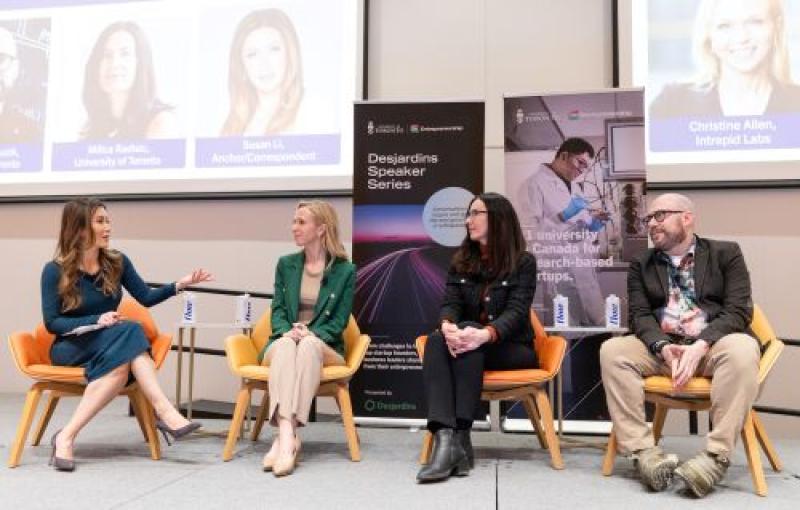
At the University of Toronto’s Entrepreneurship Week from March 2-6, three leading Canadian researchers sat down with Fox business host Susan Li during the Desjardins Speakers Series to talk about the cutting-edge AI-driven research being done in Canada. The theme of the talk was Canada’s Next AI Moment: An Ambition The World Can Trust.
Alán Aspuru-Guzik, professor of chemistry and computer science at U of T and senior director at NVIDIA research, spoke about a challenge facing people and countries around the world: the rise of plastic waste.
While many believe that tossing a plastic bottle or container into a recycling bin is reducing plastic waste getting into landfills or becoming microplastics and contaminating water supplies, Aspuru-Guzik told attendees the reality is much different.
“Humanity does not recycle almost any plastic,” he said. “Almost no plastic that you put into the recycling bin ends up being fully recycled. Sometimes, it is mechanically recycled into lower-class plastics such as recycled plastic products. That is all.”
AI is now being used in research to develop new chemical compounds for plastics so they can be recycled back to their original forms, thereby reducing waste and the amount of microplastics entering the environment.
“Every time you order something online or something comes in plastic packaging or a plastic box, the question we are asking ourselves now is how can we turn (plastic) material back to its original form, so it does not get into the environment, or becomes microplastics that we are now discovering are entering our bodies,” he said.
AI transforming research
Aspuru-Guzik said his team is building what he calls AI scientists and agents, autonomous AI systems that are able to generate hypotheses to be tested, run simulations, check results and even direct experiments.
He pointed to one system currently being used, El Agente, a large language model multi-agent system that can operate AI agents to perform complex quantum chemistry calculations for advanced pharmaceutical research.
What it has been able to do has been astounding, he said, advancing so quickly that El Agente “was at the level of a graduate student and now it is at the level of a PhD student,” he joked.
Christine Allen, CEO and co-founder of Intrepid Labs, spoke about how AI is allowing for faster drug development. She gave the example of the Tylenol medicine given to children to help them with a fever, something many mothers have given to their ill children.
“The active pharmaceutical ingredient in that Tylenol is the same for both adults and children, acetaminophen,” she said. “It’s the formulation that is different, especially for children and how to administer it safely to children so they receive the correct dose.”
She added her lab is focused on developing new formulations of pharmaceuticals and better ways to deliver more precise dosages of drugs to people. She likened it to creating an airplane to deliver passengers, in this case the pharmaceutical, to its proper destination.
What AI is offering now is the ability to do that research and testing in very short periods of time.
In one example, her firm needed to test new tablet designs for delivery of a drug. The problem they faced was the very limited supply of the drug available for the tests. This would have been a near-impossible hurdle to overcome, both because of the limited supply of the drug and the large number of tablet designs to research and test.
“There were more than 200,000 unique experiments that would need to be conducted and we had less than two weeks supply of this drug,” she said. “So using our AI-driven automated workflows, we were able to identify several promising leads that matched what they needed in less than two weeks!”
AI-powered robots
Milica Radisic, professor at the University of Toronto, Canada research chair in functional cardiovascular tissue engineering and co-founder of Tara Biosystems, spoke about how AI is now making major advancements in biological sciences and research.
AI is assisting in her work focusing on human organoids, small lab-grown tissues that can mimic human diseases more accurately than animal models. Diseases being looked at include cardiomyopathy and COVID-induced heart failure.
She even expects that in a few years, AI-powered robotic systems could assist in growing, monitoring and manipulating tissues with no human interventions for faster research results into illnesses.
Radisic speculated that a robot may very well soon grow needed tissue and cell cultures with the result “identical to what a human will get ... and one day may even know that you’re going to have heart disease before you know it.”



 Industry Events
 Locations