
 Locations







PwC Canada's latest artificial intelligence (AI) offering looks to move beyond computer screens and into mines, factories and warehouses, where AI-enabled machines can sense their surroundings to help make decisions and carry out physical tasks.
The professional services firm launched its physical AI offering earlier this month, aimed at helping companies find ways they can deploy autonomous systems and robots in their operations.
It recently marked the launch with an event that included a live robotic demonstration and panel discussions with senior leaders from Magna International, Bell Business Markets, Defence Research and Development Canada, and the Vector Institute.
Subo Chatterjee, PwC Canada’s partner and physical AI and emerging technology leader, said physical AI services are particularly well suited to companies dealing with labour shortages, repetitive work, or jobs that put employees in potentially dangerous environments.
“It’s essentially trying to fill roles that either nobody wants to do, are hard to fill, are mundane or are in high-risk areas,” he told TechNX in an interview.
Chatterjee said the firm works with clients to identify where automation could improve safety, productivity or operating costs, then determines whether physical AI is actually their best solution. From there, PwC can help build the business case, design the system architecture and assess what hardware, software and AI models would be needed.
“It’s not a hammer looking for a nail,” Chatterjee said. “It’s always been, ‘What are you trying to solve for?’”
System configuration depends on client needs
As PwC is hardware- and software-agnostic, the eventual AI system can vary widely depending on the client. PwC can help companies buy and integrate existing robotics or autonomous systems from outside vendors, or work with them to develop a customized in-house application if they want to retain their own intellectual property.
Applying AI to machines that operate in the physical world is becoming a big business. Technology research firm IDC forecasts the physical AI robotics market could exceed US$40 billion by 2029, according to a recent report. A McKinsey report found that robotics and physical AI could create at least US$1 trillion in economic value by 2040, most of it in manufacturing and logistics.
Meanwhile, over half a million industrial robots were installed worldwide in 2024, more than double the number a decade earlier, according to the International Federation of Robotics.
Robot dogs and drones already at work

While humanoid robots developed by Tesla or Boston Dynamics are attracting much of the attention around physical AI, Chatterjee said most practical applications today involve drones and quadrupeds, the four-legged machines often described as robot dogs.
In mining, drones can inspect sites and collect information that once required miners to spend hours driving around a property. Quadrupeds can perform inspections or gather operating data. In nuclear facilities, companies are testing quadrupeds for radiation monitoring before workers enter potentially hazardous areas.
“Drones and quadrupeds are fairly mature in the sense that they are out there in deployment,” Chatterjee said. “They’ve moved past the proof-of-concept stage and into field operations.”
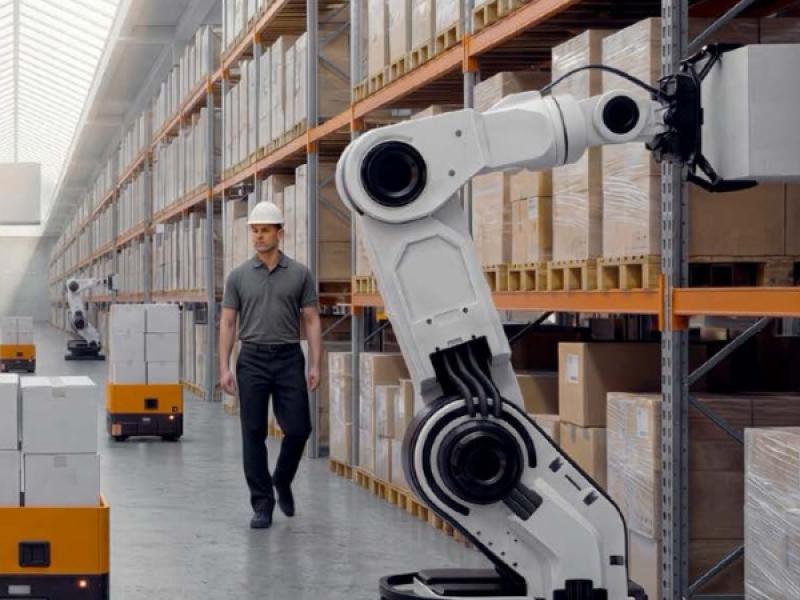
Warehouses are another use case, with autonomous systems performing repetitive pick-and-pack work on overnight shifts that can be difficult to staff. Humanoid robots, however, are still in the R&D phase, he added.
“They’re beginning to get proofs of concept and trying things out, but they’re not fully deployed for complex tasks,” Chatterjee said.
One reason why is a lack of adequate training data. Large language models that have been built using vast quantities of text and digital information don’t have the same data from mines or factories as it’s harder to collect.
“Data is the biggest challenge,” he said. “It’s not easy to get actual operational data from a mine or from a factory.”
Energy, mining, manufacturing interested in physical AI
Gone are the days when companies would spend years working on a project only to hope for a value-return when it was completed. As AI drives innovation, it has also accelerated expectations of a return on investment, resulting in quicker project turnaround. That means some projects can move from concept to deployment in less than 12 weeks, Chatterjee said.
PwC generally wants clients to demonstrate measurable value within 12 to 16 weeks before moving to the next stage, and it looks for returns of roughly two or three times the investment in most projects.
“If you cannot show quantifiable improvement, a lot of our CFOs are like, ‘Why am I doing this?’” he said.
Chatterjee estimates companies in energy, pipelines, mining, warehousing and manufacturing sectors account for about 70 to 80 per cent of the client conversations PwC is currently having. The firm is also seeing early interest from construction and power utilities.
Waiting for physical AI’s 'ChatGPT moment'
Commanding your work robot to perform a task following a verbal command is still rooted in science-fiction, but researchers are working on it, Chatterjee said.
“The faster they get there, the more you’ll get to what I call a ChatGPT moment for physical AI, where you can have a simple command and the robot will process that and execute the task,” he said. “We’re not there yet.”
For now, PwC’s bet is that drones that can inspect mines or robot dogs that enter hazardous areas will help bridge the physical AI gap until that science fiction dream can become reality.




 Industry Events
 Locations